
Complete Drip Irrigation System Installation Guide for Agriculture
Introduction
Water is one of the most valuable resources in agriculture, yet a significant amount is still lost through traditional irrigation methods. As farmers face increasing water scarcity, rising production costs, and unpredictable weather conditions, adopting a modern irrigation system has become essential rather than optional.
A drip irrigation system is one of the most efficient irrigation methods available today. It delivers water directly to the root zone of plants, reducing water wastage while improving crop health and productivity.
In this complete installation guide, you’ll learn how to install a drip irrigation system, the components required, common mistakes to avoid, and how FieldFlow Greens Pvt. Ltd. helps farmers implement reliable irrigation solutions for sustainable agriculture.
What is a Drip Irrigation System?
A drip irrigation system is a precision irrigation method that supplies water slowly and directly to plant roots through a network of drip irrigation pipes, emitters, valves, and filters.
Unlike flood irrigation, this system applies water only where it is needed, reducing evaporation, runoff, and water loss.
Key Benefits of Drip Irrigation:
- Saves up to 60% of irrigation water
- Improves crop yield and quality
- Reduces fertilizer loss
- Controls weed growth
- Minimizes soil erosion
- Lowers labor costs
- Supports sustainable farming
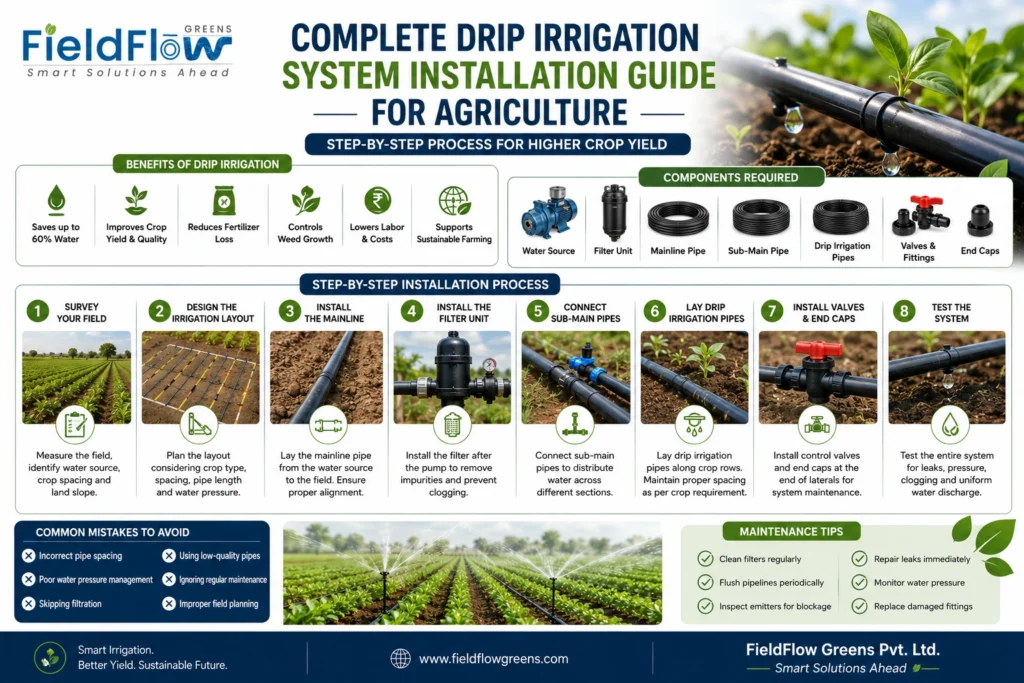
Components Required for Drip Irrigation System Installation
Before installation, gather the following components:
Water Source
- Borewell
- Water tank
- Canal
- Reservoir
Filtration Unit
A quality filter removes sand, dirt, and impurities, protecting the drip irrigation pipes from clogging.
Mainline Pipe
Carries water from the source to the field.
Sub-Main Pipe
Distributes water from the mainline to different crop sections.
Drip Irrigation Pipes
These pipes deliver water uniformly to each plant through built-in emitters, ensuring efficient irrigation.
Valves and Fittings
Used to control water flow and connect different sections of the irrigation network.
End Caps
Seal the pipeline and allow periodic cleaning of the system.
Step-by-Step Drip Irrigation System Installation Guide
Step 1: Survey Your Agricultural Field
Before installation:
- Measure field dimensions.
- Identify crop spacing.
- Note land slope.
- Locate the water source.
- Determine irrigation zones.
Proper planning improves water distribution and reduces installation costs.
Step 2: Design the Irrigation Layout
A good irrigation layout ensures every crop receives equal water.
Consider:
- Crop type
- Plant spacing
- Pipe length
- Water pressure
- Future expansion
Professional planning minimizes pressure loss and improves system efficiency.
Step 3: Install the Mainline
Lay the mainline pipe from the water source to the field.
Ensure:
- Proper alignment
- Leak-free joints
- Secure fittings
The mainline forms the backbone of the irrigation system.
Step 4: Install the Filter Unit
Install the filter immediately after the water pump or source.
A high-quality filtration system prevents clogging and increases the lifespan of drip irrigation pipes.
Step 5: Connect Sub-Main Pipes
Attach sub-main pipes according to the irrigation layout.
These pipelines distribute water evenly across different sections of the farm.
Step 6: Lay Drip Irrigation Pipes
Install drip irrigation pipes close to crop rows.
Maintain consistent spacing based on:
- Crop variety
- Soil type
- Water requirement
Proper installation ensures uniform water delivery directly to plant roots.
Step 7: Install Valves and End Caps
Fit control valves to regulate water flow.
Secure end caps to enable future flushing and maintenance.
Step 8: Test the Entire System
Run the irrigation system before planting.
Inspect for:
- Water pressure
- Leakage
- Uniform discharge
- Clogged emitters
- Proper flow
Make adjustments where necessary.
Common Mistakes to Avoid During Installation
Many farmers experience reduced efficiency due to avoidable installation errors.
Avoid:
- Incorrect pipe spacing
- Poor water pressure management
- Skipping filtration
- Using low-quality pipes
- Ignoring regular maintenance
- Improper field planning
Professional installation helps maximize the system’s performance.
Why Farmers Are Choosing Drip Irrigation
Modern agriculture demands efficient resource management.
A drip irrigation system helps farmers:
- Increase productivity
- Save water
- Reduce operating costs
- Improve fertilizer efficiency
- Produce healthier crops
- Achieve better profitability
It is an ideal solution for vegetables, fruits, cotton, sugarcane, vineyards, horticulture, floriculture, and greenhouse farming.
Maintenance Tips for Long-Term Performance
To keep your irrigation system operating efficiently:
- Clean filters regularly.
- Flush pipelines periodically.
- Inspect emitters for blockage.
- Repair leaks immediately.
- Monitor water pressure.
- Replace damaged fittings promptly.
Routine maintenance extends the life of the system and ensures consistent crop performance.
Why Choose FieldFlow Greens Pvt. Ltd.?
FieldFlow Greens Pvt. Ltd. is dedicated to delivering innovative irrigation solutions that help farmers improve productivity while conserving valuable water resources.
Our product range includes:
- Premium-quality drip irrigation pipes
- Irrigation sprinkler systems
- Agricultural irrigation accessories
- Durable pipe fittings
- Complete irrigation solutions for farms of all sizes
We focus on quality, reliability, and sustainable farming practices to support the long-term success of Indian agriculture.
Final Thought
Installing a drip irrigation system is one of the smartest investments a farmer can make. With proper planning, quality components, and correct installation, farmers can achieve significant water savings, healthier crops, and higher yields.
Whether you’re cultivating vegetables, fruit orchards, cash crops, or field crops, modern irrigation solutions provide long-term value and improved farm efficiency.
If you’re planning to upgrade your irrigation system, FieldFlow Greens Pvt. Ltd. offers dependable drip irrigation pipes and irrigation solutions designed to meet the needs of modern agriculture.
Invest in efficient irrigation today and build a more productive, sustainable future for your farm. Contact Now
FAQs
1. What is the main purpose of a drip irrigation system?
A drip irrigation system delivers water directly to plant roots, reducing water wastage and improving crop growth.
2. Which crops are suitable for drip irrigation?
Drip irrigation is suitable for vegetables, fruits, sugarcane, cotton, vineyards, flowers, orchards, and greenhouse crops.
3. How much water can drip irrigation save?
A properly designed system can save up to 60% of water compared to traditional irrigation methods.
4. How often should drip irrigation pipes be maintained?
Filters should be cleaned regularly, pipelines should be flushed periodically, and the entire system should be inspected throughout the growing season.
5. Why should I choose FieldFlow Greens Pvt. Ltd.?
FieldFlow Greens Pvt. Ltd. provides high-quality drip irrigation pipes, irrigation sprinkler systems, and complete irrigation solutions that help farmers improve efficiency, conserve water, and achieve better crop yields.