
Flat vs Round Drip Irrigation Pipe: Which One Should You Choose?
Should I use a flat drip pipe or a round drip pipe?
Both are designed to deliver water close to the crop root zone, but their construction, handling and suitable applications are different. The right option depends on your crop, field conditions, irrigation period and installation requirements.
For a complete overview of drip pipes, specifications and irrigation system kits, see FieldFlow Greens’ Drip Irrigation Pipes & Complete Drip Irrigation System Kits for Agriculture.
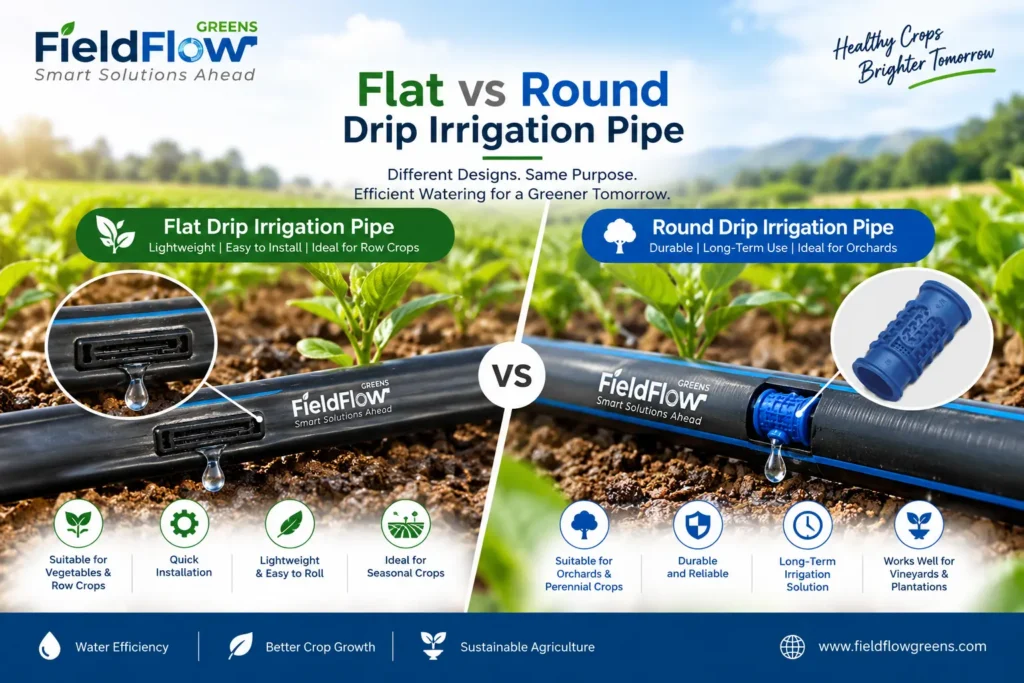
What Is a Flat Drip Pipe?
A flat drip pipe, also called drip tape in some applications, has a flattened shape when it is not carrying water. It is lightweight, easy to roll and convenient to install over large areas.
FieldFlow Greens pvt. Ltd. offers flat drip pipes in 12 mm, 16 mm and 20 mm sizes, with different wall thicknesses, emitter spacing and flow rates.
Flat drip pipes are commonly used for:
- Vegetable farming
- Row crops
- Seasonal cultivation
- Open-field agriculture
- Short-cycle crops
- Large-area installations
They can be a practical choice when quick installation and easy handling are important.
What Is a Round Drip Pipe?
A round or cylindrical drip pipe keeps its circular shape during installation. It generally has a thicker wall than flat drip pipe, making it suitable for applications where the irrigation line needs greater durability and longer outdoor use.
FieldFlow Greens pvt. Ltd. offers round drip lines in 12 mm, 16 mm and 20 mm sizes, with options including 20–50 cm emitter spacing and 2 or 4 LPH flow rates, depending on the product configuration.
Round drip pipes are commonly used for:
- Orchards
- Vineyards
- Sugarcane
- Plantation crops
- Perennial crops
- Long-term irrigation systems
Flat vs Round Drip Pipe
Feature | Flat Drip Pipe | Round Drip Pipe |
Shape | Flat when empty | Cylindrical |
Handling | Lightweight and easy to roll | More rigid |
Typical use | Seasonal and row crops | Orchards and perennial crops |
Installation | Quick and convenient | Suitable for longer-term setups |
Sizes | 12, 16, 20 mm | 12, 16, 20 mm |
Flow options | 1.5, 2, 4 LPH | 2, 4 LPH |
|
|
|
Which Drip Pipe Is Right for Your Farm?
There is no single pipe that fits every agricultural project.
Choose a flat drip pipe when you need lightweight lines for seasonal crops or large row-crop areas. A round drip pipe can be considered for orchards, vineyards and other applications where the irrigation lines are expected to remain in use for longer periods.
Your crop spacing, water pressure, soil, field layout and irrigation schedule should also be considered before selecting the pipe.
Choose the Right Drip Irrigation Solution
FieldFlow Greens supplies drip irrigation pipes, PCND dripline, PE blind pipes, filters, valves, fittings and complete drip irrigation system components for agricultural applications.
If you’re planning a new irrigation system, start with the crop and field requirements rather than choosing the pipe by size alone.
Need help selecting the right drip irrigation pipe? Share your crop, field area and irrigation requirement with Fieldflow Greens for a suitable solution.
FAQs
What is the main difference between flat and round drip irrigation pipes?
Flat drip pipes are lightweight and easy to roll, making them suitable for seasonal and row crops. Round drip pipes maintain their cylindrical shape and are commonly used for orchards, vineyards and longer-term irrigation applications.Which drip pipe is better for vegetable farming?
Flat drip pipes are commonly used for vegetable and row-crop farming because they are easy to install and handle across large cultivated areas.How do I choose between flat and round drip pipes?
Consider your crop type, plant spacing, irrigation duration, field layout and water pressure. Seasonal crops may suit flat drip pipes, while perennial crops can benefit from round drip pipes.