
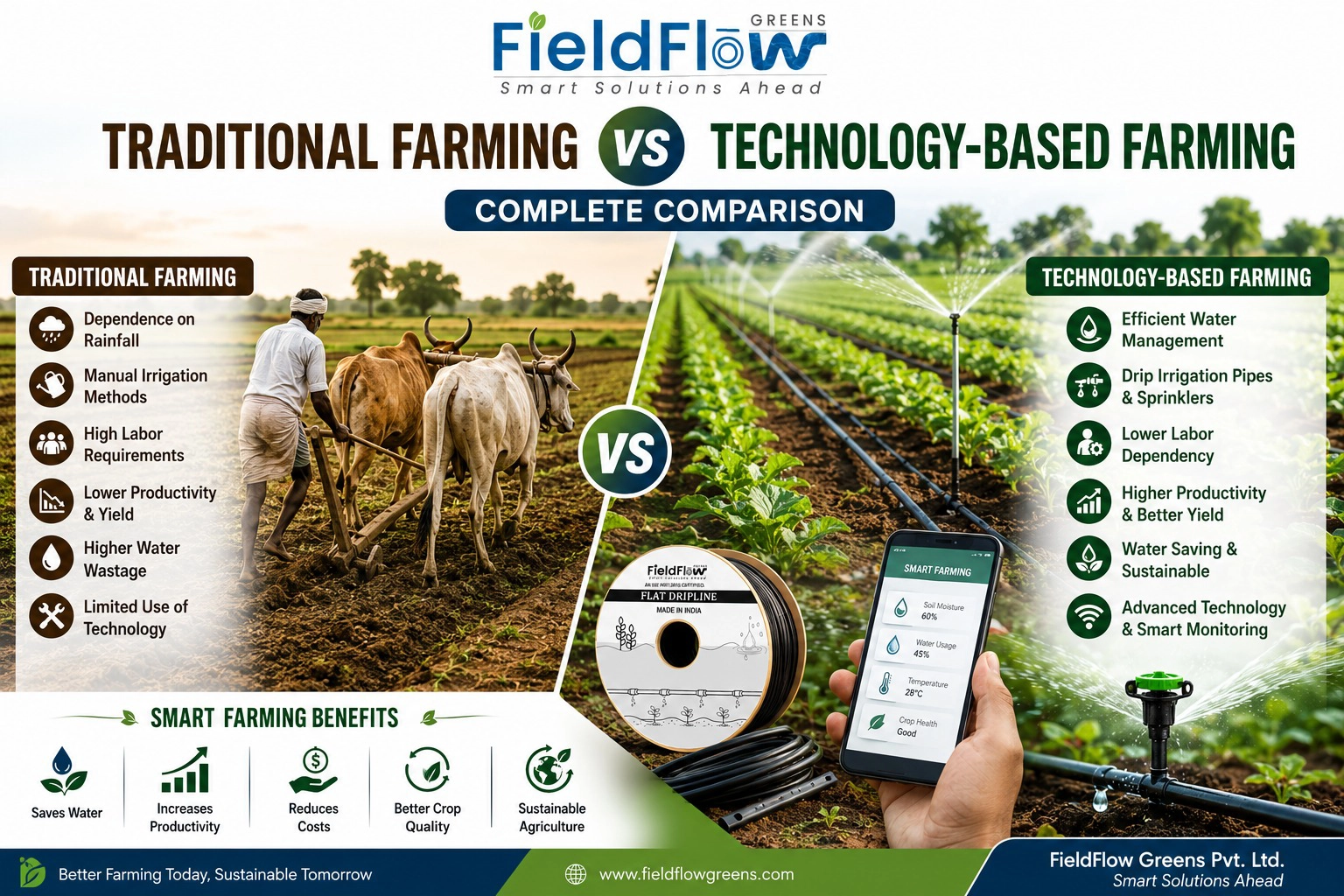
Traditional Farming vs Technology-Based Farming
Complete Comparison
Agriculture has been the foundation of human civilization for centuries. Traditional farming methods have helped generations of farmers cultivate crops and sustain livelihoods. However, with increasing food demand, changing climate conditions, water scarcity, and rising production costs, agriculture is rapidly evolving. Today, technology-based farming is transforming the agricultural landscape by improving productivity, efficiency, and sustainability.
Modern farming methods are helping farmers make better use of resources while maximizing crop yield. From drip irrigation pipes and irrigation sprinklers to advanced monitoring systems and precision agriculture, technology is enabling farmers to achieve more with fewer resources.
This article explores the key differences between traditional farming and technology-based farming while highlighting the smart farming benefits that are shaping the future of agriculture.
What is Traditional Farming?
Traditional farming relies primarily on manual labor, conventional tools, natural rainfall, and inherited farming practices passed down through generations. While these methods have supported agriculture for many years, they often face limitations in efficiency, productivity, and resource management.
Characteristics of Traditional Farming
- Dependence on seasonal rainfall
- Manual irrigation methods
- High labor requirements
- Limited use of technology
- Lower precision in resource application
- Variable crop yields
Traditional farming remains important in many rural regions, but growing agricultural challenges require more advanced and sustainable solutions.
What is Technology-Based Farming?
Technology-based farming, often referred to as smart farming, integrates modern agricultural technologies to improve decision-making and farm management. It focuses on precision, efficiency, sustainability, and maximizing productivity.
Modern farming methods utilize advanced irrigation systems, soil monitoring, automation, and data-driven practices to optimize crop production.
Characteristics of Technology-Based Farming
- Precision irrigation systems
- Drip irrigation pipes for efficient water delivery
- Irrigation sprinklers for uniform water distribution
- Improved crop monitoring
- Better resource management
- Higher productivity and profitability
- Reduced environmental impact
Traditional Farming vs Technology-Based Farming
Water Management
Traditional Farming
Traditional irrigation often relies on flood irrigation or manual watering methods. These systems can result in significant water loss through evaporation, runoff, and uneven distribution.
Technology-Based Farming
Modern irrigation solutions such as drip irrigation pipes deliver water directly to the root zone of plants. Irrigation sprinklers distribute water uniformly across the field, reducing wastage and improving water efficiency.
Advantage: Technology-Based Farming
Crop Yield
Traditional Farming
Crop productivity often depends on weather conditions, soil quality, and labor availability. Inconsistent resource application may affect overall yield.
Technology-Based Farming
Modern farming methods allow precise water and nutrient management, resulting in healthier crops and higher yields.
Advantage: Technology-Based Farming
Labor Requirements
Traditional Farming
Many agricultural tasks require significant manual effort, increasing labor costs and time requirements.
Technology-Based Farming
Automation and advanced agricultural equipment reduce dependence on manual labor while improving operational efficiency.
Advantage: Technology-Based Farming
Resource Efficiency
Traditional Farming
Fertilizers, water, and other inputs may be applied unevenly, leading to wastage and increased production costs.
Technology-Based Farming
Precision farming techniques ensure optimal use of resources, helping farmers reduce costs and improve sustainability.
Advantage: Technology-Based Farming
Environmental Impact
Traditional Farming
Excessive water usage and inefficient resource management can negatively impact soil and environmental health.
Technology-Based Farming
Smart farming practices promote water conservation, soil protection, and sustainable agriculture.
Advantage: Technology-Based Farming
Environmental Impact
Traditional Farming
Excessive water usage and inefficient resource management can negatively impact soil and environmental health.
Technology-Based Farming
Smart farming practices promote water conservation, soil protection, and sustainable agriculture.
Advantage: Technology-Based Farming
Smart Farming Benefits
The adoption of technology-based farming offers numerous advantages for modern agriculture.
Increased Productivity
Farmers can achieve higher yields through efficient irrigation, better crop management, and improved resource utilization.
Water Conservation
Drip irrigation pipes help reduce water consumption by delivering water directly where it is needed most.
Improved Crop Quality
Consistent irrigation and precise nutrient application contribute to healthier and higher-quality crops.
Reduced Operating Costs
Efficient resource management lowers water, labor, and input expenses over time.
Sustainable Agriculture
Smart farming practices support long-term agricultural sustainability while preserving natural resources.
The Role of Drip Irrigation Pipes in Modern Farming
Drip irrigation pipes have become one of the most effective solutions for water-efficient farming. These systems provide controlled water delivery directly to plant roots, minimizing water loss and maximizing crop performance.
Benefits of Drip Irrigation Pipes
- Significant water savings
- Improved root development
- Reduced weed growth
- Lower fertilizer wastage
- Better crop yield
- Suitable for various crops
For farmers seeking efficient irrigation solutions, drip irrigation systems represent a practical investment in long-term productivity.
Why Irrigation Sprinklers Are Important
Irrigation sprinklers play a vital role in modern agricultural practices by providing uniform water coverage across fields.
Benefits of Irrigation Sprinklers
- Uniform water distribution
- Suitable for large agricultural areas
- Reduced soil erosion
- Better crop establishment
- Efficient use of water resources
When combined with modern farming methods, irrigation sprinklers contribute to improved crop health and farm efficiency.
Why Farmers Are Moving Toward Modern Farming Methods
As agricultural challenges continue to grow, farmers are increasingly adopting advanced farming solutions to improve profitability and sustainability.
Modern farming methods help address:
- Water scarcity
- Rising labor costs
- Climate variability
- Increasing food demand
- Resource optimization
Technology-based farming is no longer a luxury; it has become an essential component of successful agriculture.
FieldFlow Greens Pvt. Ltd.: Supporting Smart Agriculture
FieldFlow Greens Pvt. Ltd. is committed to promoting innovative and sustainable agricultural solutions that help farmers improve productivity and efficiency.
With quality drip irrigation pipes, irrigation sprinklers, and advanced farming solutions, the company supports farmers in adopting modern agricultural practices that deliver long-term value and sustainable growth.
Conclusion
The comparison between traditional farming and technology-based farming clearly demonstrates the advantages of adopting modern agricultural practices. While traditional farming has served agriculture for generations, today’s challenges require smarter and more efficient solutions.
Through modern farming methods, farmers can conserve water, improve productivity, reduce costs, and achieve sustainable growth. Solutions such as drip irrigation pipes and irrigation sprinklers are playing a crucial role in transforming agriculture and helping farmers build a more productive future.
As agriculture continues to evolve, embracing smart farming technologies will be essential for achieving long-term success and sustainability.